Algorithmic Foundations: Python Level 1 (Competitive Track)

- Description
- Curriculum
- FAQ
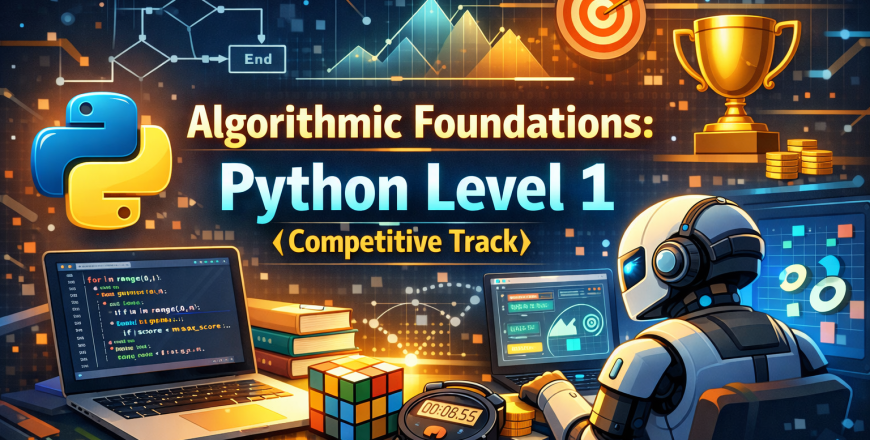
A high-rigor introduction to computational thinking and Python syntax. This course transitions students from basic coding to algorithmic problem-solving, focusing on code efficiency, logic puzzles, and structured debugging.
Target Audience: 10–12 years (Academic/Competition Track)
-
1
 The Environment & Data Streams
Master the professional Jupyter environment on iPad using Carnets. You will learn how a computer allocates memory, how to construct data "streams," and the "Clean Code" habits required for international Olympiads. We move beyond "coding" into Software Architecture.
-
2
 Python and Jupyter Notebook on iOS with Carnets
YouTube short credits to JimParshall.
-
3
 Quiz 1
-
4
[Supplementary] What's the Difference Between Casings?
Naming things when programming can be challenging when you have different naming conventions available (snake case, camel case, pascal case, kebab case).
-
5
The Logic of Branching
Master Conditional Logic—the heart of all decision-making algorithms. We will learn how to translate complex word problems into "Decision Trees" and use Python to solve multi-case math challenges that often trip up human students.
-
6
Quiz 2
-
7
[Supplementary] Luhn Algorithm
The concept of Checksums—using a mathematical rule to verify if data is "valid" without having to check a database by applying modulo arithmetric, list reversals and conditional logic.
-
8
Luhn Algorithm
-
9
Iterative Efficiency
Unlock the Power of Repetition. We will teach Python to repeat tasks automatically, build lists to store important information, and discover patterns in numbers that help solve challenging puzzles faster.
-
10
Quiz 3
-
11
[Supplementary] The Infinite Loop Mystery (Collatz Conjecture)
Combines Loops, Patterns, and Accumulation into a visual or "real-world" mathematical puzzle on The Collatz Conjecture (The 3n + 1 Problem).
-
12
[Supplementary] range()
-
13
The Game of Search: Algorithms vs. Luck.
How do computers find one specific needle in a haystack of millions? We explore Data Structures (Lists) and the logic of Searching. You will build a "Smart Guesser" that uses logic to find answers faster than any human could by guessing.
-
14
Quiz 4
-
15
[Supplementary] The Maze Runner Algorithm
In computer science, a maze is just a 2D List (like the grid we studied in Session 2) and finding the exit is the ultimate Search Problem.
-
16
Indefinite Iteration
Master the Search Party Logic. We will explore the "While" loop—the ultimate tool for searching through unknown data—learn how to build "Prime Factorizers" to simplify complex numbers, and discover how to use Break and Continue to make your code as fast and efficient as a math champion.
-
17
Quiz 5
-
18
[Supplementary] The Infinite Precision Machine (Finding Square Roots)
In competitive math and early science, we often need to find a square root or a specific value, but we don't have a direct formula. We use the "Babylonian Method" (or Square Root Algorithm). It’s a beautiful piece of logic that uses a
whileloop to "zoom in" on an answer until it is "close enough."
-
19
Functions & Modular Arithmetic
Move from writing scripts to building Logic Tools. We will learn how to encapsulate complex math into Functions, explore the power of Modular Arithmetic for divisibility, and build a "Number Theory Toolkit" to solve competition-level problems automatically.
-
20
Quiz 6